
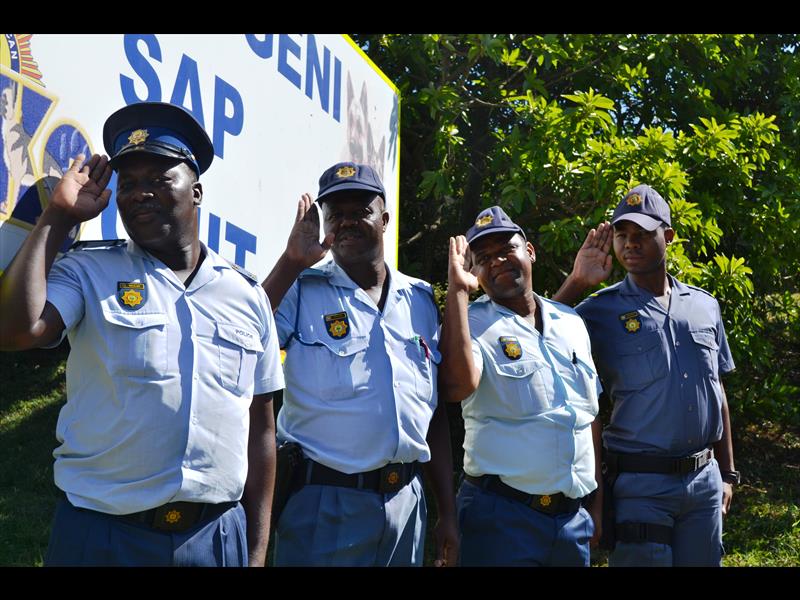

THE thin blue line that separates respect of law enforcement from absolute anarchy has dwindled to nothing more than a dot on the ever unattainable horizon.
So far more than 60 policemen have been killed in South Africa this year, most in the line of duty.
In Zululand two have been killed and a further two officers seriously wounded in the past week alone.
According to the March 2014 annual police report, the SAPS comprised a workforce of just over 194 000 people.
This roughly translates to one officer for every 347 citizens, or 288 per 100 000 – this in a country with one of the highest crime rates in the world.
More than 17 000 people were murdered here in 2013/14, drug related crimes, hijackings and violent robberies are soaring and all the while, we are suffering under a criminal element that shows no respect to a uniform.
Many are aware of ongoing court room dramas regarding the extrajudicial police killings of suspects and alleged torture, or even more famously the so-called ‘Cato Manor death squad’, a group of heavy-hitting policemen who enforced the law, by what was apparently any means necessary.
But taking decisive action, even against a criminal who has no qualms about killing policemen, can mean serious trouble for a cop.
It is the indecisive action of ranks higher up within the command structures that is to blame, and a tendency to come down on ‘loose cannon’ cops like a ton of bricks.
How can a commander sitting behind a desk, ‘condemning’ everything in sight as a blanket response, truly understand the war that rages between police and criminals?
How can prosecutors, who place themselves in no physical danger, ever have true compassion or empathy for police who are constantly backed into a corner, constantly criticised, constantly under fire and almost constantly finding themselves in life-or-death situations?
Lack of resources
Couple this to the daily obstacles our police face – vehicles that can no longer function effectively, computer systems that fail, lack of adequate funding and very often a lack of appropriate training.
Policemen are poorly paid considering the job they do and the dangerous challenges they face.
The real question is how on earth such an outnumbered, under-resourced and outgunned police force still manage to keep the criminals at bay at all.
The murder of a policeman or attacks on officers tasked with maintaining law and order, is a heinous act of defiance of the law which, in the end, impacts on the whole society.
When will the madness end?
Only when government and police command structures take the trouble to truly understand the impossible working conditions our men and women in blue are expected to function under.
They will argue there are policies in place, but the question is whether these and vital resources are adequate given the unique challenges the police force and South African society at large face in terms of the uncontrolled crime wave.
Leaders must get out of their comfort zones and rather take a hard and practical look at how to bring about effective turnaround startagies.
The current flood of lip service will change nothing.