
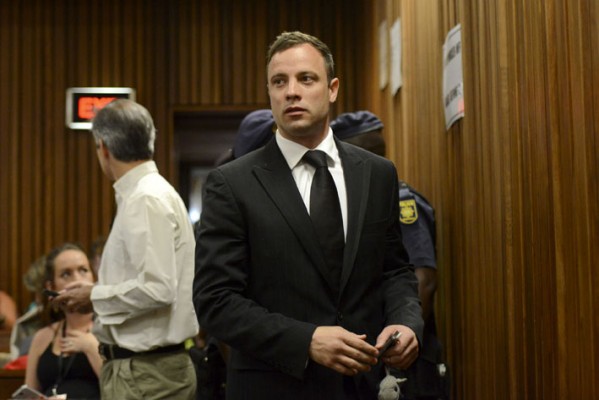

AS high court judge Thokozile Masipa on Tuesday handed down sentencing the world had been waiting for in the Oscar Pistorius trial, there was sense of relief.
Relief on the face of the sombre and disgraced 27-year-old paralympian, who stood with shrugged shoulders as he was given a five-year jail term for killing his girlfriend, Reeva Steenkamp.
Relief on the faces of Steenkamp’s parents June and Barry, who appeared visibly ‘satisfied’ that justice had been served after a harrowing 20 months.
An emotionally drained uncle Arnold Pistorius conceded that they had accepted the sentence and would support Oscar during his restorative and healing process.
But while the climactic moment was somewhat muted inside the court, outside the courtroom the public jury handed down their verdict – and the world was quick to listen.
As South Africans argued the harshness or leniency of the sentence, one sore point reared its ugly head.
Analysts and citizens alike voiced the opinion that the justice playing fields for the rich and the poor were still poles apart.
While Judge Masipa considered the sentence to be ‘fair’ and just’ both to society and the accused, the public was quick to point that a poor or ordinary man found guilty of a similar charge of culpable homicide would not have been handed such a ‘sympathetic’ sentence.
This is the not the first time the argument has surfaced, with high ranking politicians and celebrities perceived to receive far more leniency in court cases simply because of their status and money.
Pre-empting assumptions
Yet Judge Masipa was quick to react to the above assumption, almost pre-empting the fierce public backlash.
‘I’m satisfied that the Correctional Services Department is equipped to deal with inmates with disabilities. It would be a sad day for this country if an impression would be created to suggest there’s one law for the rich…..and another law for the poor and disenfranchised,’ Judge Masipa said.
But as the ‘Blade Runner’ was escorted under police guard to Kgosi Mampuru II prison in Pretoria, the next question was whether the double amputee would survive the notorious jail conditions.
At present 7 000 inmates endure overcrowding, gang violence and unsanitary conditions, but Pistorius underwent an immediate assessment to be detained in the hospital area.
In contrast, the Mngeni family wonders whether their son Xolile would still be alive if he had been granted medical parole.
Mngeni, who was sentenced to life imprisonment for the murder of Anni Dewani, died in Goodwood Prison’s hospital on Saturday after being diagnosed with a brain tumour in 2011. Nobody seemed to care or have compassion with his situation.
One trusts that every case is heard on its own merits, but there’s no denying that there are enough examples which fuels the public perceptions, whether it be true or not.What the judiciary must not forget is that perception equals reality in the public mind, and perhaps they should do more to place things in perspective.