
Fire threat still in critical phase
Critical fire season not over with expectant humidity and wind increases.
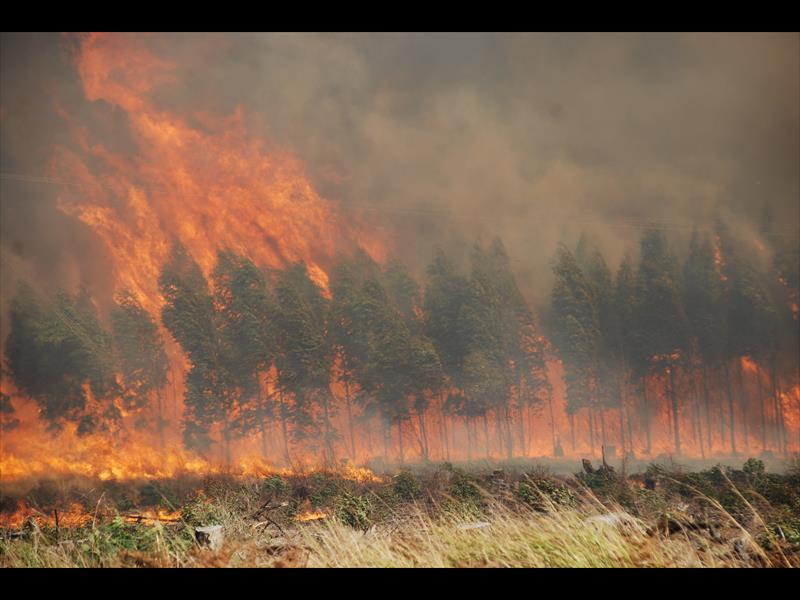

IT has been a critical fire season, and the end is not yet in sight as the humidity plummets and the wind picks up.
In the first two months of this year’s fire season (July and August), the bombers stationed at KwaMbonambi have been scrambled on 40 occasions and have flown a total of 83.6 hours, averaging just short of 42 hours per month.
They have dropped 258 loads of 1 500 litres each as they dampen down fires for the ground crews to mop up behind them.
Besides the bombers, the spotter plane has flown 49 hours over the same period.
Eucalyptus plantations have borne the brunt of the fires with just under 172 000ha having been lost while 43 400ha of indigenous bush, 13 000 Eucalyptus coppice and 9 290ha of conservation areas have been destroyed.
Zululand Fire Protection Association’s (ZFPA) fire boss, Tony Roberts says that of the 462 fires attended this year, 42.39% are believed to have been started deliberately by humans.
This means that despite on-going campaigns by the Working on Fire and ZFPA staff, warning people of the dangers of fires, the larger community has still not grasped the seriousness of the situation and continue to put lives and property at risk.
The areas hardest hit are those bordering on the uMhlatuze Municipality and the community forestry areas around KwaMbonambi.
Although extensive work with honey hunters has continued, they have been responsible for 32% or 145 fires this year.
Causes of fires
Besides deliberate fires, the weather has also been a major role player with only 345mm of rainfall since January.
The previous lowest rainfall recorded in the KwaMbonambi area was 520mm for the whole of 1992.
This year, the months of June, July and August had 10mm, 11mm and 10mm rainfall respectively.
The Fire Danger Index (FDI), a combination of various factors including temperature, humidity and wind has also been serious.
Over the same three months there have been 15, 18 and 10 ‘yellow’ codes, while there have been six, six and five ‘orange’ days.
The real worry is, however, the ‘red’ days of which there was one in July and there were two in August.
Roberts says, ‘These high FDIs are critical and people need to understand that matches are best kept in their pockets.
‘Some of the worst days in August were during the cold snap, with low temperatures but very high winds and low humidity.
‘With the dry vegetation, a fire will rapidly get out of control and become a major blaze.’
Municipalities’ responsibility
Roberts is currently investigating the non-compliance of Act 101 of 1998 (Natural Veld and Fire Act).
Under Section 4 (7) of this Act, municipalities are legally bound to be members of their local Fire Protection Association (FPA).
Failing to do so is an offence and charges can be laid under the Act.
If the municipality has ‘municipal land’ under its control, they are also legally bound under the Act to have fire breaks, fire fighting equipment and a fire plan in place.
Roberts says if these are not in order, charges can also be pressed against the municipality.