
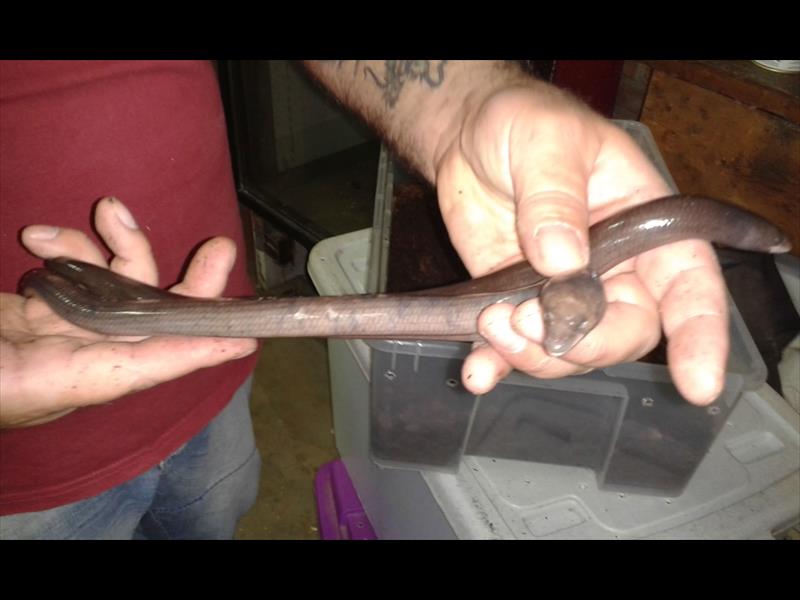

MTUNZINI’S snake catcher and curator of the Zinisnake Reptile Centre, Wayne ‘Beastman’ Rawlinson, has had a busy week rescuing a female boomslang and two Giant Legless Skinks. (A skink is a smooth-bodied lizard with short or absent limbs, typically burrowing in sandy ground).
The boomslang, or tree snake,was spotted in a tree in Ngwelezane, next to a house, creating a certain amount of anxiety among the locals according to Rawlinson. The boomslang is a relatively small snake which is also colour blind.
‘But, it has highly potent venom which it delivers through large fangs that are located in the rear of the jaw. The venom of the boomslang is primarily a haemo-toxin. It disables the blood clotting process and the victim may well die as a result of internal and external bleeding,’ explained Rawlinson.
Its diet includes chameleons and other arboreal lizards, frogs, and occasionally small mammals, birds and eggs from nesting birds, all of which they swallow whole. During cool weather they will hibernate for moderate periods, often curling up inside the enclosed nests of birds such as weavers’.
The two Giant Legless Skink’s were found under an old water tank and were almost turned into compost. The skink has a powerful body, extremely thick around the middle with a short, cylindrical tail, but it has no limbs and moves with serpentine undulations along the ground.
‘The broad head has an elongated, steel-grey snout. Like other members of the genus, it retains eyelids. It is uniform shiny black to dark brown and has smooth overlapping scales.’
This species is found in South Africa from the north eastern Limpopo province, extending through Mpumalanga to coastal northern KwaZulu-Natal and the Eastern Cape. It is also found in Swaziland, southern Mozambique and there is an isolated relic population that occurs on the eastern escarpment of Zimbabwe.
Both the snake and the skinks will be released into a more suitable environment where they will not come to harm.