
The real earthquake of Zululand
Tales of the great Zululand earthquake of 1932.

WHILE far removed from the heart of the scary earthquake that struck near Orkney late Tuesday morning, there was instant local reaction and no shortage of comment on social media.
Within minutes, the Zululand Observer’s phones were inundated with callers wanting to know if anyone else had felt the shakes; the same applied to the Fire & Rescue Services’ switchboard.
While no serious local incidents were reported, those who tended to experience the major rumblings were mostly on upper levels of multi-storey buildings and some headed for open spaces ‘just in case’.
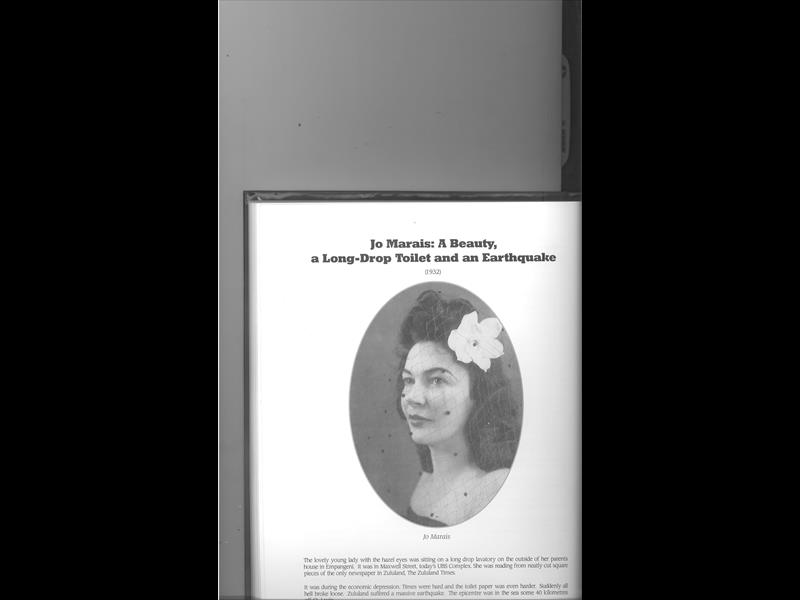
But Tuesday’s tremors pale in comparison with the great Zululand earthquake of 1932, as recounted by local historian Dr JC van der Walt.
In particular, he recalls how a beautiful young lady named Jo Marais was sitting on a long drop toilet in her Maxwell Street, Empangeni home when the earthquake struck, its epicentre in the sea some 40km off St Lucia.
‘It had an intensity of 9 out of 12 on the Mercalli scale and lasted for three minutes,’ writes Van der Walt in his ‘Zululand True Stories’.
‘Marais ran for her life as the earth trembled underfoot.
‘The ground seemed to heave. There was a low rumbling noise like underground thunder.
‘Outside, the trees and shrubs moved like waves caused by a mighty hurricane.
‘People ran out of houses and buildings in terror and a policeman climbed up a telephone pole to escape the menace on the ground.
‘The ground in the Empangeni area moved and caused people to stagger.
‘Plaster fell from the ceilings, one house collapsed completely and a few were so badly damaged they were later abandoned.
Train derailed
‘At Empangeni Rail, large corrugated iron tanks sprang leaks, burst or were dislodged.
‘At eShowe the main shock lasted two minutes, but the tremors continued for more than an hour, while at Melmoth the tremors lasted for two hours.
‘A huge fissure damaged the railway embankment north of Mtubatuba leading to the derailment of a train.
‘At St Lucia, the lighthouse lamp and lenses were thrown out of position and the big gas cylinders were moved about.
‘The violent movement flung the lighthouse keeper’s wife from a sofa onto the floor.
‘The people of Empangeni felt 18 after-shocks on 31 December and another 43 shocks until 5 February 1933.’
According to Van der Walt, the cause of the earthquake was a massive tectonic slip along a fault parallel to the Zululand coast.
‘In a formal report to the Honourable Minister for Mines, two geologists warn as follows: ‘In Zululand, where earthquakes may be expected to recur, single-story buildings should be built in preference to higher structures’.’