
Building rural communities
Amangwe Village holds its first ever AGM as an independent organisation
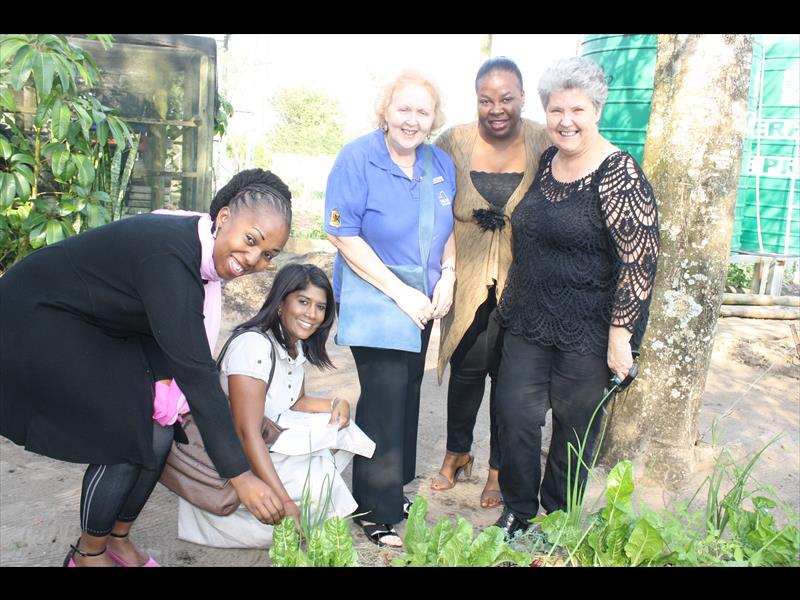

DESPITE limited resources, Amangwe Village has remained true to its mandate of providing services to rural communities and empowering impoverished individuals.
The non-profit organisation held its first annual general meeting (AGM) as an independent body last week after it was released by the Zululand Chamber of Business Foundation (ZCBF) in the past financial year.
But minimal funding posed no barrier to the public benefit organisation, whose projects have penetrated deep into outlying rural areas of the uMfolozi, Hlabisa and uMhlathuze municipalities, making a difference in needy communities.
‘Among the highlights of Amangwe Village for the year under review, was the phenomenal growth of the self-help groups, which Amangwe started in August 2009 with three groups,’ said Amangwe Village Board Chairperson, Carole Hills.
‘At the end of the previous financial year, there were 89 groups consisting of 20 individuals per group and 1 780 women. Amangwe currently manages 115 groups of 20 women – a total of 2 300 women. These numbers continue to grow daily,’ Hills said.
Generating revenue to sustain their families and communities, the local women meet weekly and contribute R2 on every occasion. One woman is appointed as a Treasurer, while another is the scribe ensuring that administration and financial skills are imparted to the rural women.
Based on an Indian model, the idea is to create a ‘loan bank’ of which money is allocated to different women according to their needs and must be repaid to ensure continuity of the cycle. Latecomers or absentees are slapped with a fine while no amounts are lent to those who have not repaid their loan. The money is then continuously circulated within the group and not hoarded.
Amangwe Village Manager, Erna Steynberg, said the groups had to date given out 28 000 loans to the value of R8-million rand.
Other successful projects include the early childhood development programme at Amangwe Village Crèche and the toy library, the home based care initiative and the organic food garden.
Hills also thanked the ZCBF Board for their direction and guidance during the transition phase to Amangwe’s independence.
‘A memorandum of understanding between the two organisations was concluded whereby, as the need arises, we are able to call on the ZCBF for support. It is vital that we manage to secure additional members onto the Amangwe Village Board. Such members need to have the spirit and drive required of an NGO – that is to give freely, expecting nothing in return,’ said Hills.