
Am I at risk of skin cancer?
CANSA have some quick and simple tips on how to recognise signs of skin cancer

EACH year during the hot summer months, CANSA steps up its skin cancer awareness communication through its SunSmart campaign, to remind South Africans of the dangers of over-exposure to the sun.
‘Most South Africans love the outdoors, especially at this time of year.
‘Our Sunsmart campaign’s title is really self-explanatory – we’re saying ‘have fun, but be smart about it.
‘We all need to be aware of the damage the sun can do, but we don’t need to fear it.
‘You can enjoy the outdoors without suffering from sunburn, as long as you are SunSmart,’ says CANSA CEO, Elize Joubert.
According to the World Health Organization (WHO), the incidence of both non-melanoma and melanoma skin cancers has been increasing over the past decades.
Who is at risk?
People at high risk include those with:
• Fair skin that burns easily in the sun
• Personal or family history of skin cancer
• Lots of moles, that is, more than 50
• And those who are being treated with immuno-suppressive drugs
If you are at high risk, you should make protecting your skin in the sun a priority.
In addition, try to get as much vitamin D as possible from sources other than the sun, such as your diet and supplements.
How to recognise skin cancer
You don’t need any x-rays or blood tests to identify skin cancer early – just your eyes and a mirror.
If you have skin cancer, finding it early is the best way to make sure it can be treated with success.
Check the moles on your skin carefully every month.
Ask a family member or friend to examine your back and the top of your head.
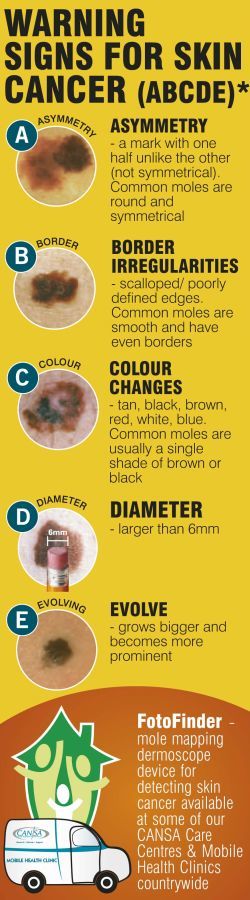
If you notice any of the following ABCDE warning signs, you need to see a doctor or dermatologist immediately:
A – symmetry: a mole or mark with one half unlike the other (common moles are round and symmetrical)
B – order irregularities: scalloped or poorly defined edges (common moles have smooth and even borders)
C– colour variations and inconsistency: tan, brown, black, red, white and blue (common moles are usually a single shade of brown or black)
D– diameter: larger than 6 mm.
E – Evolving: changes in the shape, colour or border of a mole.
‘The key message is that everyone is at risk of getting skin cancer, it doesn’t matter how old you are, your skin type or where you live.
‘It’s up to you to work to lower the skin cancer risk.
‘Ensure you are protected in the sun, know your family history and skin type and do your monthly mole check,’ says Joubert.
Preventative measures include:
Eating a diet rich in antioxidants, omega-3 fatty acids, fruits, and vegetables.
They all contribute to fighting free radicals, which lowers the risk of cancerous cell growth.
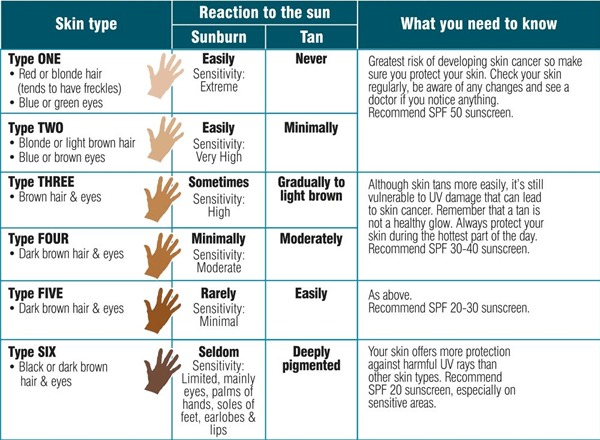
Always apply sunscreen regularly (SPF of 20 – 50) according to skin type.
People with fair skin have a higher chance of getting skin cancer, while dark-skinned people are still at risk.
Darker skin has more protective melanin pigment and the incidence is lower in dark skinned people.
However, skin cancers do occur and they are often detected at a later, more dangerous stage.
Screening
CANSA has five mole-mapping dermoscope devices called the FotoFinder used to examine moles and help reduce the risk.
Every client with suspicious skin damage is referred for an intensive skin evaluation.
Examinations are available at some CANSA care centres.
HAVE YOUR SAY
Like our Facebook page and follow us on Twitter.
For news straight to your phone invite us:
WhatsApp – 072 069 4169
Instagram – zululand_observer