The chips are up!
With an annual turnover of some $221-million, not only is the industry a huge contributor to foreign exchange earnings and the local economy, it is also a major employer

WHILE other commodities are battling against declining prices and diminishing markets, the woodchip industry is thriving, particularly in Richards Bay.
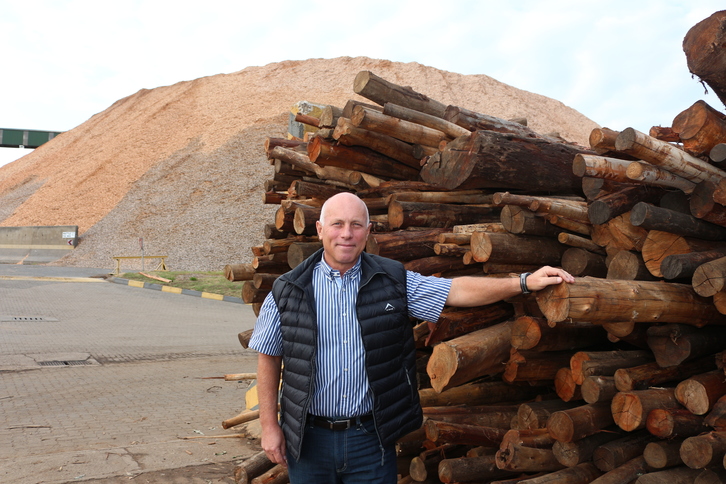
That’s the good news from TWK agri-boffin’s John Swaine: GM Timber Exports and New Business Development, who says demand and supply have equalled and the commodity has rallied in 2016.
And with most contracts running over three years, short term prospects are healthy.
‘The industry peaked in 2005 when over 5 million tons were exported, but declined to 3 million tons in 2008 and then to 1.5 million tons in 2012 following reduced demand resulting from the 2009 world financial crisis,’ said Swain.
‘We were also affected by the tsunami of 2011 in Japan which affected production at many facilities.
‘The industry fortunately has been able to recover our export volumes to 2.5 million tons while other commodity export volumes have reduced.’
Shipping
There are four woodchip production facilities in Richards Bay and one in Durban.
Up to 20 ships will arrive at the port this year for TWK, and 60 for the total industry.
The woodchips are shipped in specially designed vessels that sail empty from Asia and over three days take on a full 35 000 – 45 000 ton load at the port’s dedicated terminal.
‘With an annual turnover of some $221-million, not only is the industry a huge contributor to foreign exchange earnings and the local economy, it is also a major employer,’ said Swaine.
The TWK Richards Bay plant employs 70 staff, while the diversified group, owned by 470 mostly farmer shareholders, provides jobs for about 1 700 staff.
‘The timber for woodchip production and export is almost exclusively supplied by mainly small to medium size growers and multi-crop farmers in Mpumalanga, KZN and Swaziland.
‘In many cases it is their sole source of income,’ said Swaine.
‘The upstream forestry industry providing the logs is very labour intensive, creating many work opportunities in rural areas where trees are grown.
‘The drought has had some effect on the industry, mostly in terms of lower yields, but currently, the biggest challenge is our reliance on Transnet.
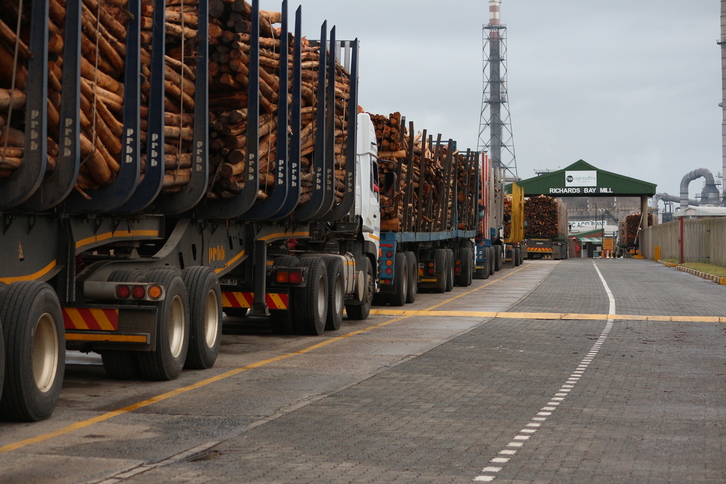
‘About 80% of our timber arrives by road and the remainder by rail, which is impacted by limited loco availability and breakdowns.
‘This is frustrating, as we would ultimately like to take timber totally off the roads.
‘Unreliable pilot boat, tug and helicopter services as well as quayside equipment problems result in ship demurrage costs.
Woodchip facts and figures
• SA exports woodchips mainly to Japan (75%), India (20%) and China (5%) for use in the production of pulp and paper
• China is the largest paper and paper board producer in the world, ahead of the USA and Japan
• Both Japan and China import most of their woodfibre required for their pulp and paper industries
• SA’s woodchip industry started over 40 years ago with the export to Japan of Black Wattle woodchips, grown for the bark from which tannin is extracted for the leather tanning industry
• SA has surplus hardwood (Wattle and Eucalyptus) timber resources, which are converted into woodchips and sold as an export commodity.